Role clarity in a high value giving programme: The foundation for sustainable growth.
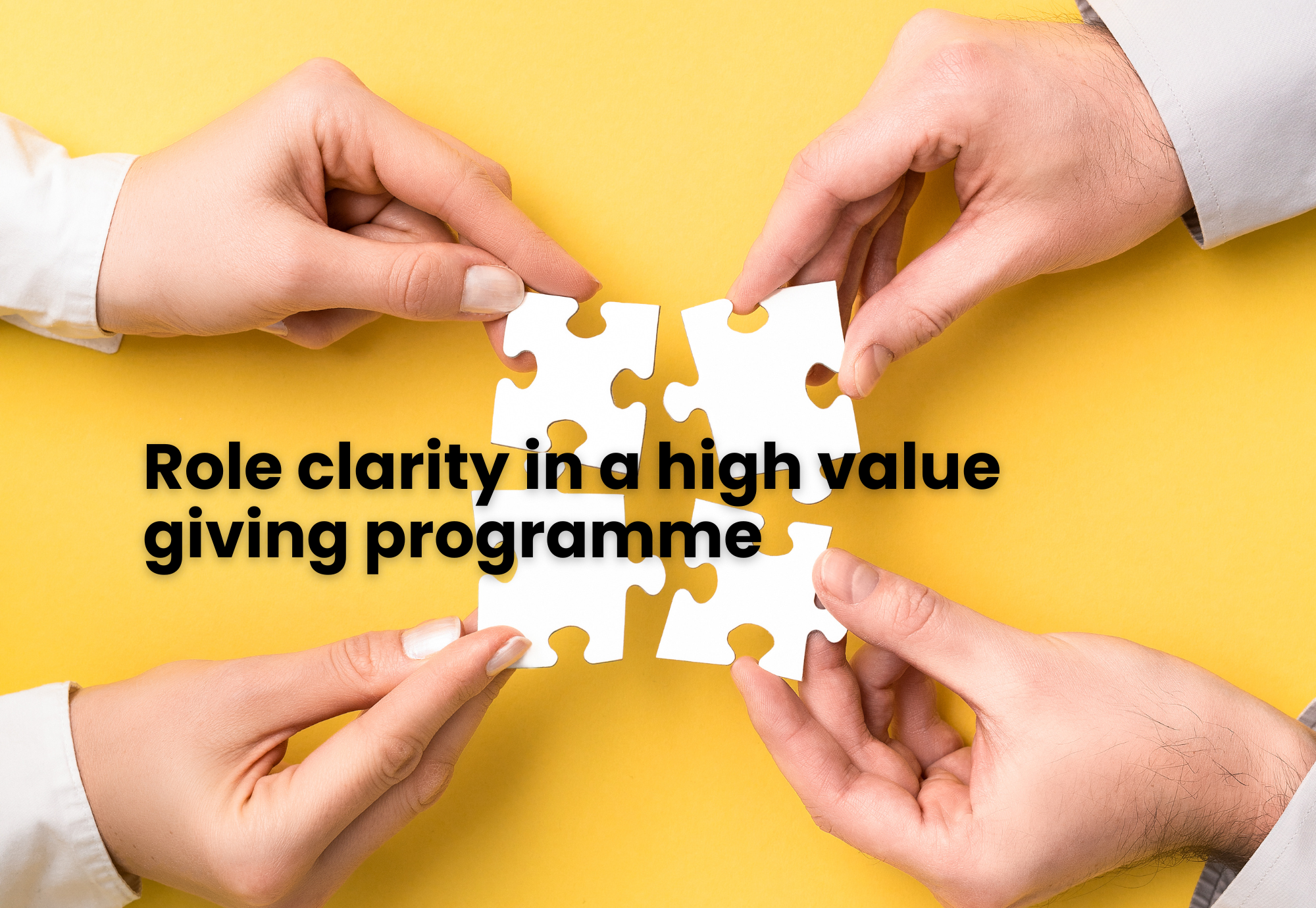
Who does what across the CEO, board, and staff in small, medium, and large organisations | By Giving Architects
High-value giving grows when an organisation is coordinated, confident, and consistent. Donors do not experience your internal structure. They experience how you show up: who follows up, who leads conversations, how clear the priorities are, and whether the organisation is steady enough to trust with a significant investment.
That is why role clarity matters at every size of for-purpose organisation planning to develop high-value donor relationships. It is not about creating bureaucracy. It is about making it easy for people to understand the impact of partnership, to contribute easily and at scale, preventing mixed messages, and ensuring the donor journey keeps moving. The roles will look different in a one or two-person fundraising team compared with a ten-person fundraising team, but the essentials stay the same.
At its core, every high-value giving programme needs five functions covered, no matter your size: leadership sponsorship, advocacy and introductions, relationship management, asking, and stewardship. The only difference is how many people share those functions.
The CEO: champion, align, and be present where it counts
The CEO is the sponsor of high-value giving. Their job is to make sure it is taken seriously, aligned to strategic priorities, and supported internally. For donors, the CEO’s direct involvement signals leadership, stability, and accountability. For staff and board members, the CEO sets the tone that philanthropic revenue is a leadership priority, not a side project.
In practice, CEO involvement should be purposeful. The CEO should be present in moments where leadership presence increases confidence: key relationship-building meetings, significant invitations to partner, and high-impact experiences for committed partners. When the CEO’s role is clear within the fundraising function, donors receive meaningful engagement without the CEO becoming the person who has to carry every relationship or chase every next step.
In a small organisation, this often means the CEO holds more relationships personally, because there are fewer people to share the load. In a medium organisation, the CEO usually stays involved with a defined top tier of relationships and supports staff to lead the rest. In a large organisation, the CEO’s time is typically reserved for the most strategic relationships and the moments where their involvement materially shifts donor confidence.
The board: govern well, advocate, extend networks, and strengthen credibility
A board’s contribution to high-value giving is often misunderstood. Boards are not there to replace a fundraising function, nor should they be pushed into uncomfortable cold asking. Their strongest value lies in governance, credibility, advocacy and introductions.
Governance means the board understands and endorses the high-value strategy, supports the right level of resourcing, and keeps an informed eye on progress. Credibility means their visible involvement reassures donors that the organisation is well governed and trustworthy. Advocacy and introductions mean they help create warm engagement with networks that staff cannot reach alone.
Across organisations of all sizes, board involvement works best when it is coordinated and specific. Rather than telling board members to “help with fundraising”, give them clear and realistic roles: making introductions, hosting small conversations, attending selected donor meetings, or participating in a major partnership invitation when their relationship adds trust. Many organisations also encourage board members to make a personal gift at a meaningful level for them, not as a revenue tactic, but as a signal of leadership and integrity.
In small organisations, boards can feel closer to operations, so coordination becomes even more important to avoid multiple approaches to the same donor. In medium organisations, board members can be effective connectors and hosts, especially when supported with a good briefing and clear next steps. In larger organisations, board members often play a more strategic ambassador role, supporting flagship relationships and major campaign invitations to partner.
Staff: build the discipline and follow through that makes growth repeatable
Well-equipped, supported and trained staff are the engine room of consistent high-value giving. They bring the structure that turns relationships into a reliable philanthropic investment. This includes planning and managing the pipeline of supporters, coordinating leadership and board involvement, preparing for invitations to partner, and engaging with supporters in a way that makes donors feel valued and confident.
How that looks depends on your size.
In a large organisation, responsibilities are often distributed across fundraising leadership, major gifts staff, donor care, operations, and program teams. Fundraising leadership owns the strategy and performance rhythm. Major gifts staff own portfolios and manage relationships day to day. Operations and donor care ensure data, acknowledgements, reporting, and stewardship are executed with professionalism. Programme leaders support credibility by clarifying outcomes and helping translate work into fundable opportunities.
In a medium organisation, some of these responsibilities are combined. One person may manage major gifts relationships and also oversee operations. Another might lead fundraising overall while still holding a small portfolio. This can work extremely well, provided ownership is clear and the operating rhythm is protected.
In a small organisation, staff roles are often best described as “hats” rather than job titles. You still need the same functions, but one person may wear several hats. Someone must own relationships day to day. Someone must own follow-through and data. Someone must own impact content and propositions. Often the CEO is one of those people, which makes coordination even more essential.
What changes by size is not the strategy, it is the allocation
A useful way to think about scale is this: as organisations grow, you do not add new functions, you distribute them across more people.
Small organisations (two to three people multitasking) tend to succeed in high-value giving by being selective and disciplined. The CEO is usually more directly involved in donor relationships, and follow-through must be systemised so it does not slip. In this context, clarity often looks like this: every donor has one named relationship owner; the CEO is brought into agreed moments; and there is a simple system to ensure next steps, thank yous, and stewardship happen on time.
Medium organisations often sit in the sweet spot where you can be highly personal while also building structure. The CEO can focus on top-tier relationships and key asks, while fundraising staff lead most relationship management and keep the pipeline moving. The board can be used intentionally for introductions and selective participation. Operations might still be lean, so protecting time and routines becomes important.
Large organisations can run sophisticated, high-performing programmes because they have capacity, but they can also become complex. Role clarity becomes vital to avoid duplicated donor contact, mixed messaging, and slow decision-making. In these environments, the CEO and board should be used with discipline, staff should have clear portfolio ownership, and stewardship should be system-driven and consistent.
The small team operating models that work
If you are small and trying to “do major gifts” without a major gifts department, the structure matters even more than the headcount.
A classic three-person model is: CEO as sponsor and top-tier engager, one fundraising lead as relationship owner and pipeline manager, and one operations or admin person protecting follow-through. If you only have two people, it can still work, but you need a lighter system and tighter focus: fewer donors in active cultivation at once, a short weekly review, and calendar-based stewardship so nothing relies on memory.
If you do not have a fundraiser at all, you can still build high-value giving, but it must be very selective. The CEO will lead relationships and invitations to partner, while another role must protect time, manage follow-up, and keep information organised. Even modest external support can help here, particularly for proposals, systems, and stewardship planning.
The practical rules that make role clarity work at any size
Regardless of your structure, a few simple rules dramatically improve effectiveness.
First, every donor should have one clear relationship owner. Donors should never have to guess who is leading the relationship. Second, leadership involvement should be planned, not reactive. The CEO and Board are most powerful when their involvement is intentional and well-briefed. Third, stewardship should be systemised. High-value giving is strengthened by consistent, thoughtful follow-up, and that is much easier when it is built into routines and calendars. Finally, keep an operating cadence. A short monthly pipeline review for medium and large organisations, or a short weekly review for small teams, protects momentum.
Bringing it all together
Role clarity is one of the most practical ways to grow high-value giving because it strengthens both the internal system and the external experience. When the CEO champions and shows up where it counts, the board governs and opens doors, staff drive a disciplined pipeline with strong follow-through, and donors feel confident. They experience an organisation that is aligned, purposeful, and ready for investment.
Whether you are a small team juggling multiple responsibilities or a large organisation with a dedicated fundraising function, the principle is the same: clarity creates consistency, and consistency builds trust. Over time, that trust becomes the foundation for high-value revenue to grow steadily and sustainably.